

New Report: LGR & Devolution - From Anticipation to Opportunity

Today we've published our latest report: LGR & Devolution: From Anticipation to Opportunity - with findings from Tile Hill's second annual survey of senior local government leaders, exploring how reorganisation and devolution are shaping their careers, their teams and their organisations.
We surveyed 170 senior officers in June and July, before the Government's announcement on 7th September confirmed a pause and partial withdrawal of LGR decisions. While attention is understandably focused on what that announcement means for the future of LGR, our findings point to a more immediate challenge that's already unfolding: senior leaders across local government are already deciding whether to stay, leave, retire, or pursue opportunities elsewhere. Those decisions will shape the sector's capacity to deliver for communities long before any final reorganisation plans are confirmed.
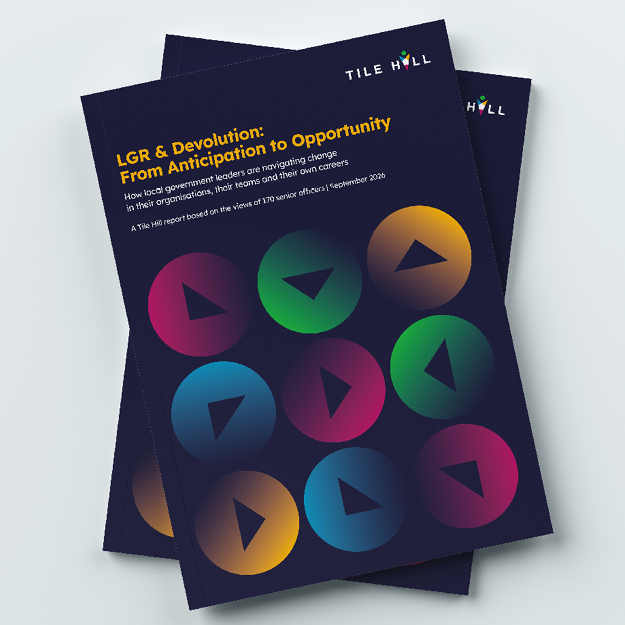
Click here to download your copy of the full report
What we found
75% of respondents said LGR had already influenced their career plans, up from 61% a year ago. 70% were concerned about staff leaving because of the proposed changes. 18% were considering bringing retirement forward. More than a quarter (28%) were considering leaving local government altogether. These findings reveal the extent of uncertainty already in the sector before the latest reset. While the future shape and timetable of LGR may continue to evolve, it doesn't automatically restore confidence, reverse a career decision, or remove the pressures being felt by teams and organisations.
For some leaders, this week's announcement may provide breathing space, or reassurance that there's time to reconsider. For others, it may simply extend a period of uncertainty they were already trying to resolve. We recognise both of those experiences are real, and that people are sitting with this news in very different ways right now. Either way, the workforce implications remain significant.
The question this raises
A year ago, our first survey explored how senior leaders were anticipating reorganisation. This year's findings show how that prospect was already shaping their decisions — and read against the latest announcement, they raise an important question: how do councils continue delivering for their communities when many of the people needed to lead that work are questioning where their own future lies?
The greatest risk may not be which structure is best, but the loss of experienced leaders whose knowledge, relationships and leadership capacity will be difficult to replace — at exactly the point local government needs strong leadership to navigate reform. If anything, the latest developments may accelerate that risk rather than reduce it, encouraging people to act rather than wait. These are decisions with consequences not just for individuals, but for the resilience of local government itself.
What this means for councils now
The immediate task for councils isn't to wait for certainty, but to create it where they can: being open about what's known, honest about what isn't, and engaging meaningfully with the people who'll determine whether organisations have the capacity to deliver through change. Workforce planning can't wait for final structures to be agreed - people's career decisions won't wait that long.
How we can support you
We stand alongside both organisations and individuals throughout periods of change. We care deeply about the people who lead public services and the communities they serve. Our role is to help councils understand and prepare for the workforce implications of reform, while supporting leaders as they consider the next stage of their own careers.
The future shape of local government remains uncertain; the future of its workforce doesn't have to be. Our hope is that the findings, reflections and experiences shared in this report help prompt those conversations, encourage early action, and support a more diverse, resilient and sustainable leadership pipeline for the years ahead.
If you’d like to have that conversation, and need to talk through your options in the light of the recent announcement, the team and I are available and you book time in our diaries here.
Method & Sample
This is the second in a series of surveys tracking senior leaders’ experience of reorganisation. 170 participants from Unitary, County and District Councils completed an online survey during June and July 2026. The sample included participants from different role levels and profession/service areas, as well as a mix of demographics.
- The survey sizes are comparable: there were 185 participants in 2025 and 170 participants in 2026.
- Base sizes for each question vary but all base sizes are large enough for analysis purposes.
- The sample is broadly comparable: all participants were senior officers working nationally in local authorities.
- More specifically, the sample is broadly comparable in terms of demographics (as illustrated below).
- Please note, there is some variation between the surveys in terms of organisations, professional roles and areas which should be considered if analysing the findings by sub groups including authority type, role type and service area.
| % of sample | 2025 | 2026 |
|---|---|---|
| Gender | ||
| Male | 56% | 50% |
| Female | 41% | 42% |
| Prefer to self describe | 0% | 0% |
| Non binary | - | 1% |
| Gender fluid | - | 1% |
| Prefer not to say | 3% | 6% |
| Age | ||
| 18-24 | 0% | 1% |
| 25-34 | 2% | 1% |
| 35-44 | 18% | 15% |
| 45-54 | 41% | 41% |
| 55-64 | 30% | 33% |
| 65+ | 4% | 3% |
| Prefer not to say | 4% | 7% |
|
Disability, impairment, condition or access need |
9% | 12% |
| Ethnic background | ||
| White / White British | 87% | 89% |
| Asian / Asian British | 2% | 0% |
| Black / African / Caribbean / Black British | 3% | 2% |
| Mixed of Multiple Ethnic Groups | 1% | 3% |
| Prefer not to say | 7% | 6% |
|
Region |
||
| East Midlands | 11% | 10% |
| East of England | 17% | 25% |
| London | 11% | 6% |
| North East | 1% | 2% |
| North West | 13% | 4% |
| South East | 21% | 24% |
| West Midlands | 10% | 10% |
| Yorkshire and the Humber | 4% | 7% |
|
% of sample |
2025 | 2026 |
|---|---|---|
| District Council | 38% | 38% |
| County Council | 20% | 22% |
| Unitary Authority | 34% | 29% |
| New or shadow Unitary Authority | - | 2% |
| Combined Authority | 2% | 15% |
| Mayoral Combined | - | 2% |
| Other | 6% | 5% |
----
| % of sample | 2025 | 2026 |
|---|---|---|
| Chief Executive | 17% | 11% |
| Corporate / Strategic / Executive Director | 22% | 33% |
| Director | 23% | 31% |
| Head of Service | 23% | 31% |
| Other | 7% | 10% |
| Prefer not to say | 8% | 3% |
----
| % of sample | 2025 | 2026 |
|---|---|---|
| Finance | 23% | 10% |
| Legal | 5% | 9% |
| Strategy / Transformation / Policy | 26% | 12% |
| HR | 15% | 15% |
| IT | 9% | 6% |
| Adult's Social Care and Education | 9% | 7% |
| Children's Social Care and Education | 11% | 12% |
| Public Health | 1% | 2% |
| Regeneration and Economic Development | 20% | 13% |
| Housing | 15% | 12% |
| Highways and Transport | 5% | 3% |
| Environment, Planning and Community Services | 14% | 18% |
| Other | 13% | 6% |
| Prefer not to say | 1% | 1% |




Sign up to newsletter
By submitting your details you agree to our T&Cs